
- Article
Keep the following in mind when building foundations
Foundations are, quite literally, the base of every building. While they seem robust and impervious, their longevity largely hinges on adequate water protection. Neglecting proper waterproofing can lead to severe issues - from dampness and cracks to mould growth and even a weakened structure. This raises the question: how can foundations be adequately protected against the adverse effects of water?
Learn the key principles and proven practices effective for both large-scale investments and single-family home construction.
Soil Testing: The Foundation of Effective Protection
Before any construction begins, geotechnical studies are essential. These studies determine the groundwater level, as well as the soil type and its permeability, all of which are crucial for selecting the appropriate waterproofing solution. For instance, low-permeability soils like clay and silt can lead to stagnant water. In such scenarios, a light damp proofing won't suffice; a comprehensive waterproofing system will be necessary. It's highly recommended to consult with your construction manager at this stage, as they can advise on the safest and most effective solutions.
Selecting Waterproofing: Three Levels of Protection
The type of waterproofing should be adapted to the water and ground conditions and the specific structure. Selecting Waterproofing: Three Levels of Protection
Light Waterproofing (Damp-Proofing) – this is suitable for situations where the groundwater level is consistently low and the surrounding soil is highly permeable. It primarily protects against rising damp through capillary action and is ideal for houses without basements located in dry areas.
Medium Waterproofing (Non-Pressurized Water Protection) –recommended for impermeable soils and where intermittent moisture may occur, such as after heavy rainfall. This level of protection addresses water that does not exert hydrostatic pressure.
Heavy Waterproofing (Pressurized Water Protection) – this is essential in environments with a high groundwater table or where water is present near or above the building's foundations either permanently or periodically, thus exerting hydrostatic pressure.
How to determine which waterproofing is suitable? Determining the Right Waterproofing: Key Questions to Ask
Does groundwater consistently appear near or above the foundations?
Is the subsoil composed of impermeable materials (e.g., clay) that could retain water and lead to temporary ponding?
Will the building incorporate a basement?
If you answered "no" to all three questions, light damp-proofing is typically sufficient. However, it's crucial to remember that water and ground conditions can change over time. Factors like heavy rainfall or the urbanization of an area, including deforestation, new roads, housing developments, or car parks, can significantly alter these conditions, potentially rendering lightweight solutions inadequate in the future. Should you answer "yes" to even one of the questions, you will need to opt for medium or heavy waterproofing, carefully selected to suit the specific local conditions.
NEXLER Foundation felt – effective and easy-to-install horizontal insulation
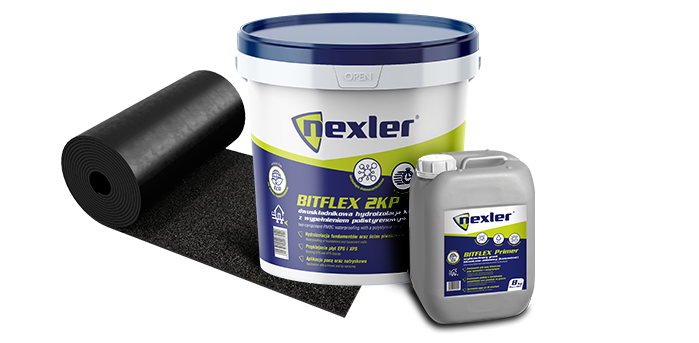
For many investors, particularly first-time single-family home builders, the crucial questions extend beyond "how to insulate foundations?" to "how can it be done effectively and affordably?" The continuity of waterproofing insulation is absolutely key. Both horizontal and vertical waterproofing layers must form a seamless, "bathtub-like" barrier, completely isolating the building's interior from moisture. NEXLER Fundation felt excels in this application. This material is specifically engineered to provide effective protection against capillary moisture absorption, all while being remarkably simple to use.
Notably, NEXLER Fundation felt is designed for horizontal insulation directly beneath foundation walls. Unlike standard PE foil, which is prone to punctures and fails to provide complete watertightness at joints with vertical insulation, NEXLER Fundation felt creates a durable, uniform barrier, even at the seams. This effectively eliminates the risk of water seepage in critical areas. Installation is remarkably simple – the felt is laid dry with a minimum 8 cm seam, requiring no welding or gluing, which significantly simplifies and speeds up the work.
The felt is available in widths of 25, 33, and 50 cm, allowing for precise adjustment to the foundation's width without the need for cutting. This guarantees the stability of the brick walls and full compatibility with vertical insulation, providing the building with lasting protection.
Properly selected and correctly installed horizontal insulation is fundamental for protecting walls against capillary moisture. It's also an indispensable element for the connection with vertical insulation, most often achieved using KMB masses.
KMB NEXLER BITFLEX Masses: Effectiveness and Safety
KMB masses from the NEXLER BITFLEX line offer an effective and secure waterproofing solution, designed to perform reliably against current and future risks. Thanks to innovative fine-particle technology, these products achieve superior substrate penetration and form a flexible, watertight coating with high adhesion.
Compared to traditional thin-layer dispersions, KMB BITFLEX masses are more resistant to damage and dry faster. Furthermore, fewer layers are needed to achieve the required thickness, speeding up application. An additional benefit of the BITFLEX products is their ability to form a robust barrier against radioactive radon, a naturally occurring gas found in the ground.
Why Skimping on Waterproofing is a Costly Mistake?
Many investors, seeking to save money during construction, often opt for less durable solutions or simplify the waterproofing process. This, however, is a false economy. Such shortcuts simply don't guarantee the long-term protection of the structure. Mistakes made during foundation insulation are not only costly but also incredibly difficult to repair. Seemingly cheaper materials frequently demand more layers or specific application conditions, and the expense of repairing damp foundation walls almost always far outweighs any initial savings on materials. Ultimately, compromised insulation leads to serious consequences and expensive renovations down the line.
Products used

BITFLEX 1K
Thick-layer waterproofing compound (PMBC) modified with polymers
Find out more
BITFLEX Quick Spray
Bituminous-latex anionic emulsion, to be used with a coagulant with spray method
Find out more
BITFLEX 2KP
Two component thick-layer waterproofing compound (PMBC) modified with polymers with a polystyrene filling
Find out more
BITFLEX 1KP
Thick-layer waterproofing compound (PMBC ) modified with polymers with a polystyrene filling
Find out more
BITFLEX 2K
Two-component thick-layer waterproofing compound (PMBC) modified with polymers
Find out more
BITFLEX Primer
Quick-drying bituminous and anionic primer (concentrate)
Find out more